Era
1980s
The 1980s brought IKEA global ambition and postmodern colour. The catalogue filled with saturated reds, blues and yellows, and the company crossed the Atlantic and began pressing into Eastern Europe for the first time.
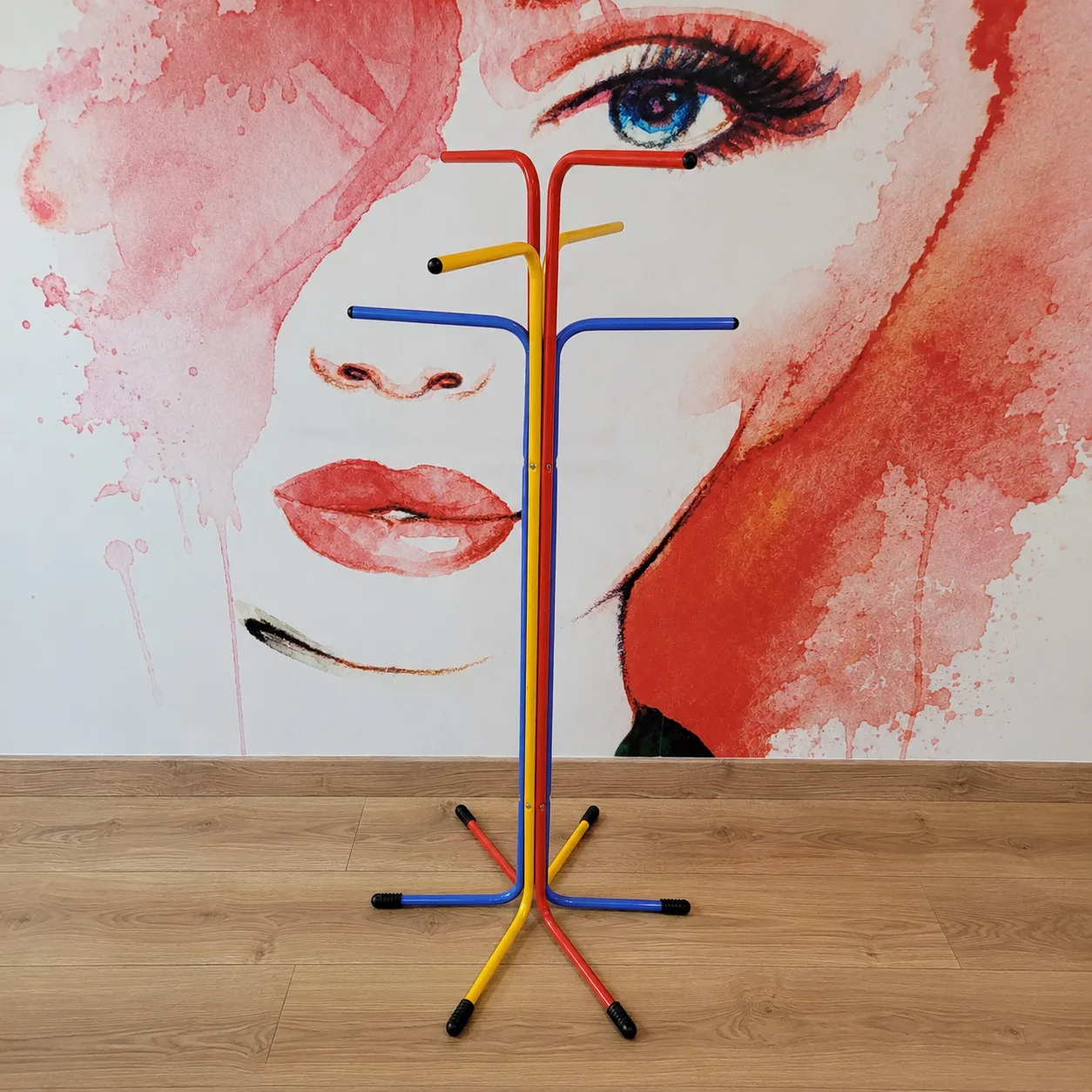
The defining designer of the decade was Danish architect Niels Gammelgaard, who arrived at IKEA with a radical question: why should furniture look like furniture? His JÄRPEN chair, introduced in 1982, was a seat woven from thick steel wire, directly inspired by a visit to a shopping-trolley manufacturer. It became an immediate favourite among younger buyers. Two years later, in 1984, Gammelgaard went further with the MOMENT sofa: a steel-mesh underframe in one carton, cushions in another, the world’s first sofa designed to be flat-packed. Its hospital-trolley aesthetic was a deliberate provocation, blurring the line between domestic comfort and industrial utility. Rutger Andersson contributed a complementary piece of postmodern wit with the SMED coat stand, introduced in 1983: eight rotating hooks on a powder-coated steel mast, configurable in multiple arrangements.
Yet the decade’s biggest icon had launched a year earlier. Gillis Lundgren designed the BILLY bookcase in 1979, named after an IKEA advertising manager who asked for a bookcase just for books, and the 1980s turned it into a global symbol. Modular, adjustable, inexpensive, and relentlessly practical, BILLY became the default answer to the question of where to put one’s books. IKEA estimates one is sold every five seconds.
The IKEA catalogue was becoming a cultural artefact in its own right during this period: a full-colour vision of attainable middle-class living, distributed in tens of millions of copies. IKEA was no longer a Swedish exporter. It was becoming a global institution.